
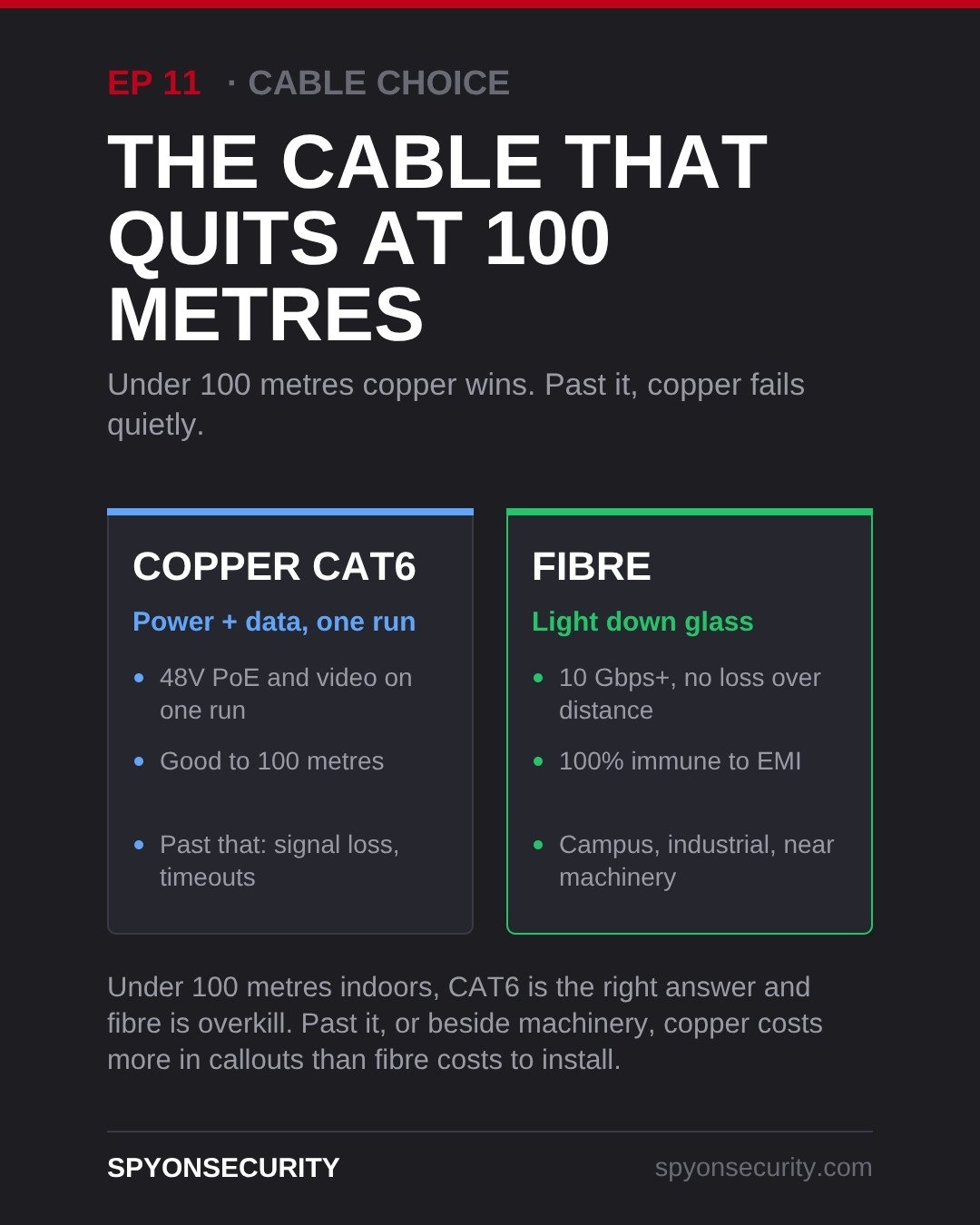
How far can you run network cable to a security camera? The honest answer is 100 metres — that is the hard limit for CAT5e or CAT6 carrying PoE and video together, and one metre past it the camera starts dropping offline. If your run is longer than that, or it passes close to heavy machinery, you need fibre instead of copper.
Why copper is the default for CCTV
On a modern IP camera system, one network cable does two jobs at once. It carries 48V Power over Ethernet from the switch to the camera, and it carries the video data back to the NVR. No separate power supply at the camera end, no electrician running a circuit out to the eaves. That is why CAT5e and CAT6 are the standard for IP cameras and network video recorders — one cable, one termination, and the whole thing is cheap to install and easy to replace.
For most homes and small commercial sites that is the correct answer. A camera at the front door, one on the driveway, two along the side of the building — none of those runs come close to the limit.
The 100-metre rule, and what happens past it
The 100-metre figure is not a manufacturer being cautious. It is the point at which the electrical signal has attenuated enough that the data stops arriving intact. At 39 metres you are fine. At 83 metres you are fine. Push the same cable to 110 metres and you get signal loss, connection timeouts and a camera that appears on the recorder, drops, and reappears.
The part that catches people out is that nothing looks broken. The camera, the switch and the recorder are all healthy, so the camera gets swapped and the new one does exactly the same thing. If a camera keeps dropping and nobody can explain why, measure the cable run before you buy anything.
Interference: the other reason copper fails
Distance is only half of it. Copper carries electricity, which means it also picks up electromagnetic interference from whatever it passes. Run a camera cable alongside a production line, a large motor, a welding bay or an electrical room, and you get interference spikes in the data. The symptom is the same intermittent dropping, and it can happen on a run well under 100 metres.
What fibre does differently
Fibre sends light down glass strands rather than electricity down copper. That changes the failure modes completely: 10 Gbps and up, effectively no attenuation over the distances a camera site involves, and total immunity to electromagnetic interference. Armoured fibre handles outdoor, buried and industrial runs.
Fibre does cost more per run and needs proper termination, so it is not a blanket upgrade. The places it earns its keep are specific — building-to-building on one property, a camera at the far end of a yard or lot, any run beside machinery or an electrical room, and backhaul on a site with a lot of cameras feeding one recorder.
What we recommend for Kitchener-Waterloo properties
Around the region, the two jobs that cross the 100-metre line most often are rural and agricultural properties and the industrial units through Cambridge and the Guelph corridor. A farm gate or a barn 300 metres back from the house is not a CAT6 run, no matter how much cable is on the reel. Neither is a camera at the back fence of a long warehouse yard.
Winter matters too. Southern Ontario freeze-thaw cycles are hard on marginal terminations — a joint that works in October starts failing in January as water gets into the connector and the temperature swings. On outdoor runs we use proper rated cable and sealed enclosures regardless of which medium we are running, and on long exterior stretches between buildings we default to armoured fibre, because going back out to a failing splice in February is nobody’s idea of a good afternoon.
For a typical Kitchener or Waterloo home, none of this applies. CAT6 to every camera, a decent PoE switch, done.
FAQ
Can I just add a repeater or a second switch to go past 100 metres?
Yes, a mid-span PoE extender or a small switch in a weatherproof enclosure will get you another 100 metres, and on some sites that is the sensible fix. The trade-off is that you have added a powered device outdoors that can fail, which means another thing to go and look at. Past one hop, fibre is usually the better long-term answer.
Is fibre worth it for a house?
Almost never. Unless you have a detached shop, barn or garage a long way from the main building, every run on a residential property is comfortably inside the copper limit and fibre is overkill.
How do I know how long my cable run actually is?
Walk the route, not the straight line — cable goes up walls, across ceilings and around obstructions, so the real length is often half again what the distance across the property suggests. On an existing run, a cable tester with a length function gives you the exact figure.
Not sure which way your site should go? We offer a free site survey across Kitchener, Waterloo, Cambridge and Guelph — we will measure the actual runs, tell you where copper is fine and where it will cost you more in callouts than fibre costs to install, and quote it properly. Call 226-227-7966 or get in touch here.